





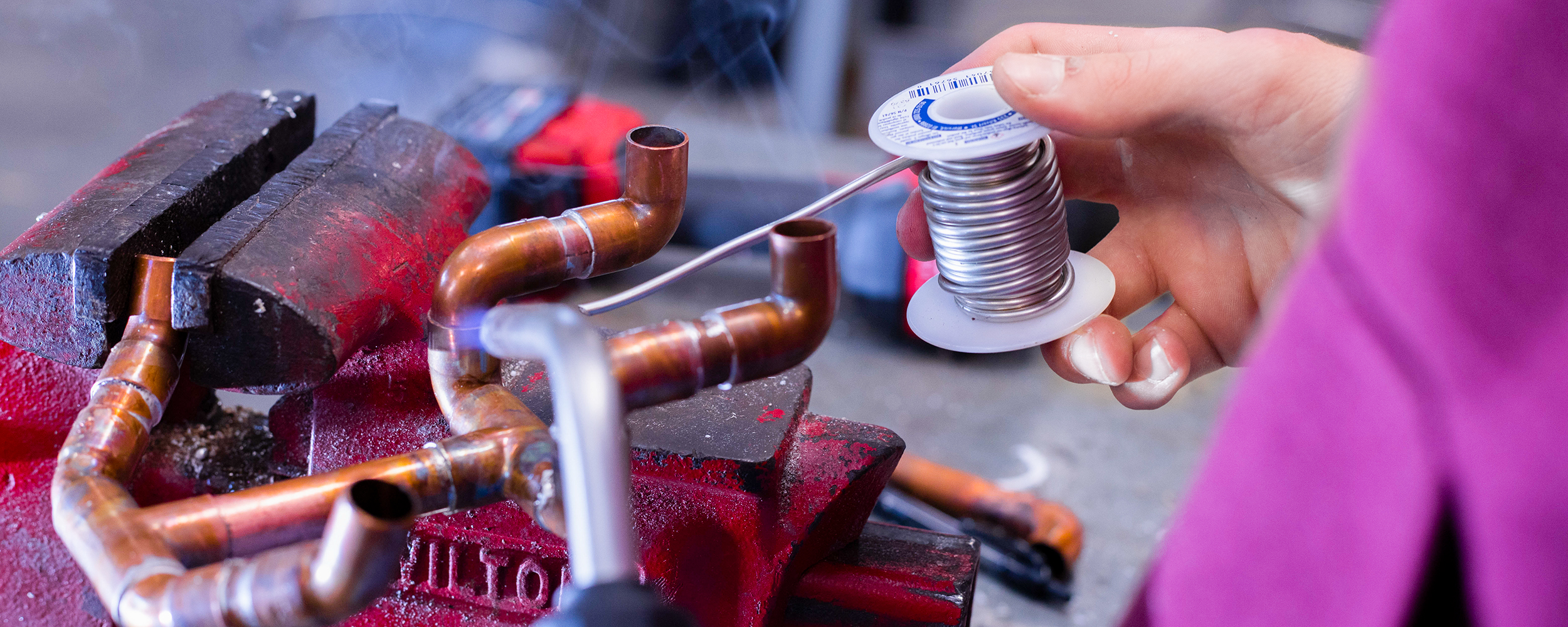
The Electrical & Plumbing Program is designed to prepare students to enter their career area as an apprentice.
Certifications
- American Heart Association Heartsaver® CPR/AED
- OSHA Construction Safety Certification
- NCCER Core
- NCCER Plumbing 1 and 2
- NCCER Electrical 1
- Year One Vermont State Apprenticeship Certificate for Electrical & Plumbing
- 400 hours of practical experience toward the student’s apprenticeship
Advisory Board
- Dick Densmore—Needham Electric
- Alex Potvin—UA Local 693
- Eric Parker— Johnson Energy
- Dan Hammond — JDW Mechanical
- Craig Susman—The Granite Group
- Justin Grenier—Green Mountain Power
- John Diekel – Master Plumbing & Heating
- Steve Ellerin—Excel Plumbing and Heating
The Electrical & Plumbing program will help students develop skills to enter their chosen career though the VT Apprenticeship program or continue studies at the college level. The classroom experience is enhanced by on-site practical applications in our plumbing and electrical labs and other electrical or plumbing construction projects in the area. In addition, students have a hands-on introduction to applications in Solar and Wind Renewable Energy, Energy Conservation, HVAC, Blueprint Reading, and Electrical & Plumbing HVAC System Design.
What We Do
 Classroom studies and practical application in our labs as well as other projects are combined with community service activities to offer a well-rounded experience. Students will design, build, plumb, and electrify a typical residential bathroom while following all relevant building codes. Second-year students will journal their work-based learning as documentation of their learning in the field.
Entry Requirements
Recommended Prerequisites: Add, subtract, multiply and divide whole numbers; understand and work with fractions; basic customary and metric measuring skills; able to read a tape measure; ability to perform physical labor on the job site and in the classroom; competency with fine and gross motor skills.
Level 2 Student Requirements In order for a student to return for a second year in the program they must secure a work-based learning experience prior to completing their first year. The student also must successfully complete OSHA 10 and NCCER Construction Core.
Embedded Credits: 1 Science OR 1 Math
Program Instructor – Chris Tooley
 Chris Tooley joined Stafford in August of 2018. He arrived in the Rutland area in 1992 following his enlistment in the U.S. Army, has worked in the local plumbing and heating industry for 25 years, and has helped train and mentor many Stafford graduates. Chris is a Master Plumber and a Gold Certified Oil Heat Technician.
ch**********@****vt.org (802) 770-1056
Program Instructor – Robbie Stubbins

Robbie Stubbins joined Stafford in August 2024. He was born and raised in Rutland. He started working in the electrical field in 2010 and the family company, Stubbins Electric, was purchased in 2015. Robbie obtained his Master Electrician license in 2016. Robbie graduated from the University of Maine Farmington with a degree in secondary education. He enjoys spending time with his family first and foremost. He also enjoys spending time outdoors hiking, camping, and canoeing secondly. His other love is the Boston Red Sox and loves going to Fenway Park.
770-1189

Electrical
The left side of the graphic includes the Stafford Technical Center logo and the phrase:
Career Tree – Education with Purpose
This infographic uses the image of a large tree to illustrate career pathways in Electrical. The tree begins with roots that represent the personal and educational foundation needed for career success. The trunk symbolizes growth, and the tree branches into three progressively higher levels of careers represented by layered platforms surrounding the tree.
Graphic Structure
Foundation (Roots)
The roots of the tree are labeled with four foundational elements:
- Academics
- Experiences
- Professional Skills
- Passion
These elements are presented as the basis for career development.
Level 1 – Entry-Level Careers
With Program Completion
Examples include:
- Apprentice Electrician
- Solar Installer
- Apprentice Fire Alarm Technician
- Apprentice Security System Installer/Technician
- Cable Television Installer
- Utility Worker
- Solar Electrical Salesperson
- Maintenance Helper
- Pipe/Gas Line Apprentice
- Entry-Level Robotic Technician
- Supply House Salesperson
- Material & Equipment Delivery Person
Level 2 – Technical Careers
Apprenticeship, Associate Degree, Advanced Certification, Experience, etc.
Career options include:
- Journeyman Electrician
- Lighting Designer
- Energy Efficiency Technician
- Hydro Electrical Technician
- Estimator
- Aviation/Aerospace Electrician
- Low Voltage System Technician/Fire & Security
- Audio Visual/Data Communications Technician
- Industrial Control Specialist
- Marine Electrician
- Solar & Wind Renewable Energy Technician
- High Voltage Line Worker
Level 3 – Professional Careers
Bachelor’s Degree, Master’s Degree, Ph.D., Specialized Training, Experience, etc.
Career options include:
- Electrical Engineer
- Master Electrician
- Aircraft Electrical Technician
- Electromechanical Engineer
- Electrical Estimator
- Nuclear Engineer
- Renewable Energy System Designer
- Company Owner
- Electrical Inspector
- Electrical Designer/Architect
- Electrical Instructor
- Utility Lineman
Key Message
The tree represents a progression of career development:
- Strong roots are built through academics, experience, professional skills, and passion.
- Students can begin in entry-level construction careers after program completion.
- Additional education, certifications, apprenticeships, and experience lead to technical careers.
- Higher education and specialized training provide pathways to professional careers with greater responsibility and leadership opportunities.
The visual emphasizes that career growth is continuous and that each stage builds upon the previous one.

Plumbing
The left side of the graphic includes the Stafford Technical Center logo and the phrase:
Career Tree – Education with Purpose
This infographic uses the image of a large tree to illustrate career pathways in Plumbing.
The tree begins with roots that represent the personal and educational foundation needed for career success. The trunk symbolizes growth, and the tree branches into three progressively higher levels of careers represented by layered platforms surrounding the tree.
Graphic Structure
Foundation (Roots)
The roots of the tree are labeled with four foundational elements:
- Academics
- Experiences
- Professional Skills
- Passion
These elements are presented as the basis for career development.
Level 1 – Entry-Level Careers
With Program Completion
Examples include:
- Apprentice Plumber
- Laborer
- Petroleum Storage Installer
- Pipelayer
- Custodian
- Shop Fabricator/Shop Stock Room Inventory Control
- Material Handler
- Supply House Employee (Delivery, Counter)
- Sales Associate
- Solar Energy Installer
- Plumbing/Maintenance Technician
Level 2 – Technical Careers
Apprenticeship, Associate Degree, Advanced Certification, Experience, etc.
Career options include:
- ourneyman Plumber
- Kitchen and Bath Design
- Wastewater Technician
- Gas/Fuel Technician
- Efficiency Designer
- Solar Heat Installer/Technician
- Geothermal Systems Installation
- Sprinkler Fitter
- Steam Fitter
- Job Foreman
- Pipe Fitter
- Backflow Inspector
Level 3 – Professional Careers
Bachelor’s Degree, Master’s Degree, Ph.D., Specialized Training, Experience, etc.
Career options include:
- Master Plumber
- Wholesale General Manager
- Plumbing Instructor
- Mechanical Engineer
- Business Owner/Entrepreneur
- HVAC Engineer
- Efficiency Engineer
- Service Manager
- Plumbing Designer/Architect
- Desalinization Specialist
- Fire Protection & Prevention Engineer
- Building and Code Inspector
Key Message
The tree represents a progression of career development:
- Strong roots are built through academics, experience, professional skills, and passion.
- Students can begin in entry-level construction careers after program completion.
- Additional education, certifications, apprenticeships, and experience lead to technical careers.
- Higher education and specialized training provide pathways to professional careers with greater responsibility and leadership opportunities.
The visual emphasizes that career growth is continuous and that each stage builds upon the previous one.